
Method
Why I wrote my taste down
Every studio I compete with uses the exact same models, weights and component libraries, and we all have the same afternoon to ship something that works. The only thing left that does not arrive in an update is taste, and taste is useless to a business if it stays trapped in one person's head. So I wrote mine down, as a document with clear rules that can actually be enforced or refused.
I came to this from painting jackets
Before any of this was software it was garments. I painted jackets and then built a clothing brand around them, and what decided whether a piece worked was never the idea, since everybody has ideas, but whether the execution earned the attention it was asking for. A jacket with a great concept and a bad hand looks like a costume, and you can feel that from across a room. A song works the same way: it is a structure you either respect or break on purpose, and breaking it only reads as intent when the rest of the record proves you knew the rule.
None of that changed when the output became interfaces. What changed is that I now hand the work to a machine that has read everything and believes none of it. A model has no opinion about whether a card should be a glass slab or a flat rectangle with a one pixel border, and it will give you either for as long as you keep asking. If you do not bring the opinion yourself, you get the average of everything, which is exactly what most AI work looks like.
What is actually in the file
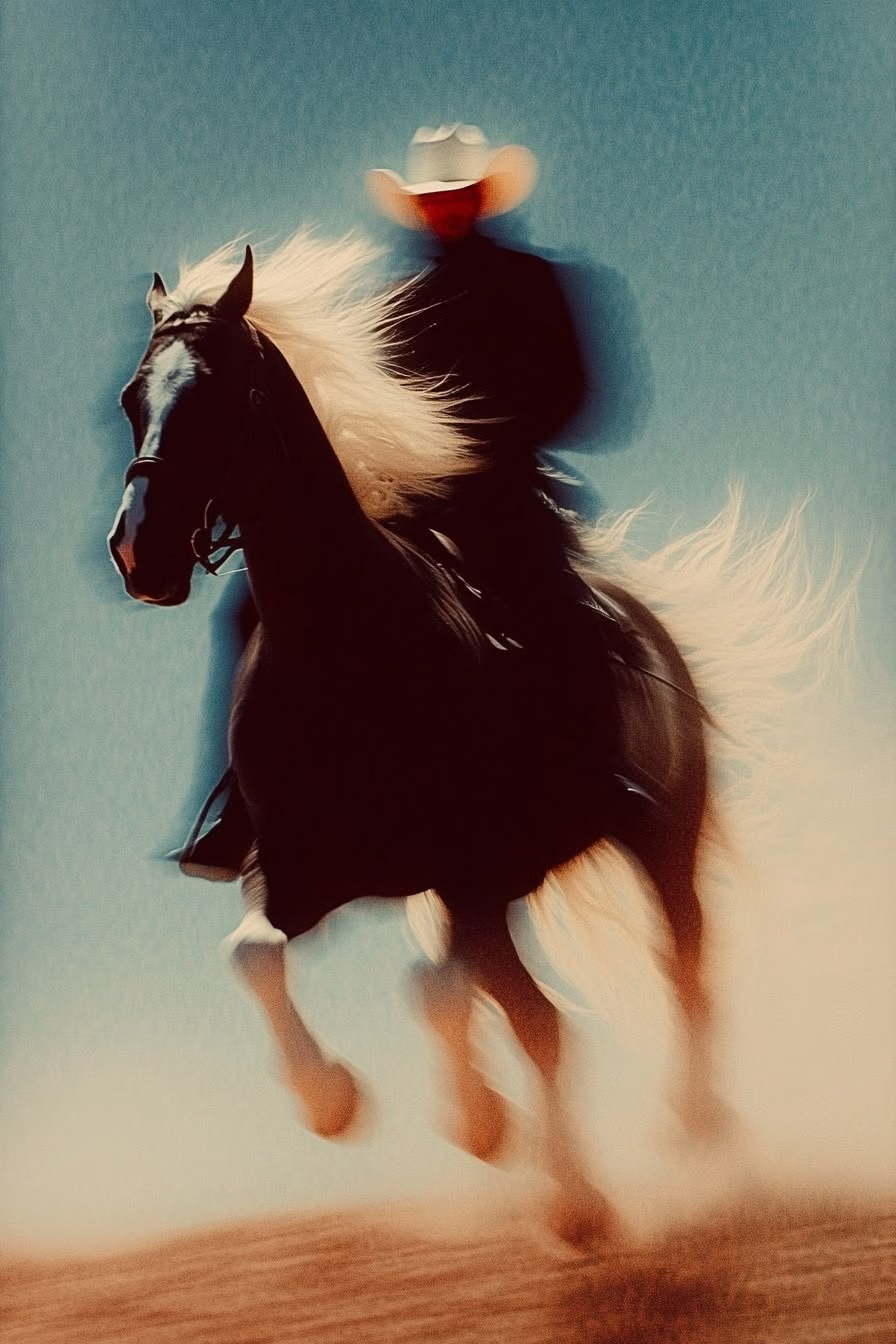
The file is called DESIGN-DNA.md, and every rule in it has to serve its opening line: dark luxury glass, physical data, cinematic presentation. Under that sit eight principles marked non-negotiable. The first says beauty must carry information, so the oversized numeral is the metric and the orbit is the chart, and any ornament that cannot justify itself that way gets cut however good it looks on its own. Another asks for one hero per screen, a single saturated element on a neutral field, because when two things glow nothing glows. A third keeps real editorial photography behind the frosted layers with the technology in front of it, which is the jackets showing up inside a technical specification.
The section that changes the output most is the list of what the aesthetic is not: flat cards with grey borders on white, more than one saturated gradient on a screen, pure black backgrounds, neon cyberpunk excess, sharp corners, default chart styling, emoji standing in for icons, and stock photos of people smiling at laptops. Each of those marks a specific place the average pulls you toward, which is why it has to be named. A rule like make it beautiful can never be broken, whereas never two glowing elements can, and catching yourself breaking it is the whole reason to write rules down in the first place.
How anything new gets in
New reference material gets analysed shot by shot before anything is taken from it, and a pattern only becomes a principle once it has turned up in at least two independent sources, or when I simply love it and say so. I kept that second clause deliberately. Pretending taste is purely empirical would be its own kind of dishonesty, but writing the exception down means I can later tell a rule that earned its place from a mood I happened to be in that week.
Why it has to be a file
The document is loadable, so an agent reads it before it writes a single line of code, which puts the constraint in front of the first decision rather than at review, when changes are expensive and I am already attached to whatever is on the screen. Most of the work is generated in the end; it simply had something to read before it started. That is the real shift: turning taste from a mood you apply when you are paying attention into a system that holds the line even on the days you are exhausted.